Season One of the Steppe: How to Binge Mongolia in the Right Order
Everyone plans Mongolia like a grocery run. Ger stay, check. Gobi, check. Eagle hunters if the flight works out, check. Then they land in Ulaanbaatar, blow through the whole country in twelve days, and fly home having seen everything and understood nothing.
I think about this place differently. After enough trips out there, I've come to see the steppe the way you'd approach a prestige drama: there's a Season One, there's an order to the episodes, and there's absolutely homework you should do before the pilot. Skip the setup and the big moments won't land. Get the sequence right, and by the time you're standing in the Altai in February, you'll feel like you've been watching this show for years.
The Pilot Episode: A Ger Stay Within Reach of the City
Don't start in the Gobi. I know it's the poster shot. But dropping a first-timer into the deep desert is like starting a series at episode seven — you don't know the characters yet, so the drama means nothing.
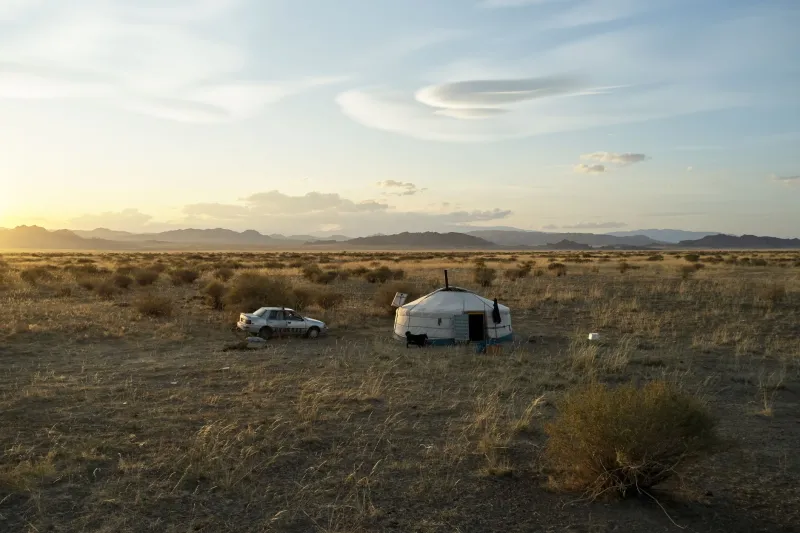
Your pilot episode is a family ger within a day or two of Ulaanbaatar. That's it. You learn the choreography: clockwise around the stove, tea offered with both hands, the door facing south, the honor of the seat across from the entrance. None of it is written down anywhere. You absorb it the way you absorb a sitcom's running gags — by sitting through a few episodes.
If you walk into the Gobi without this grounding, you're a tourist. Walk in after a week of ger life and you're a guest. Same itinerary, completely different show.
Mid-Season Arc: The Orkhon Valley and Central Routes
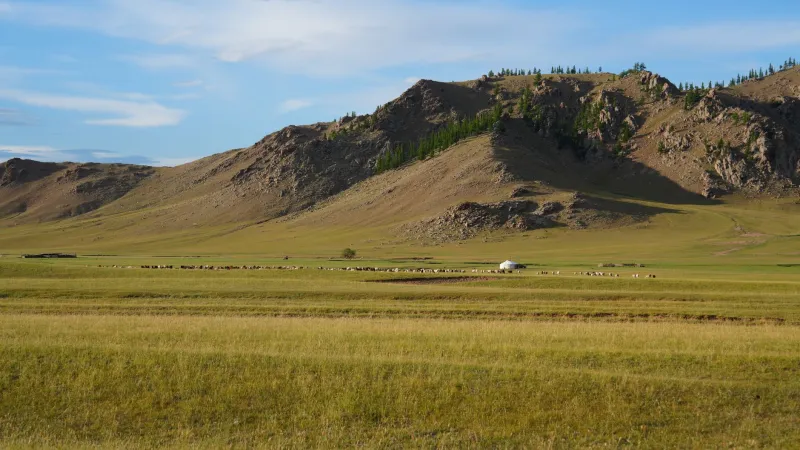
The middle of the season is where the pacing lives. The Orkhon Valley, Karakorum, the terrain where the grass starts folding into hills — this is the connective tissue of the country, the long conversational episodes that make the finale hit.
Give it time. Americans especially struggle here, because we're trained to optimize. There is nothing to optimize in the Orkhon Valley. The episode is the drive itself, the river crossings, the herds you stop for, the lunch that becomes three hours because a neighbor rode over. If you're checking your watch, you're watching it wrong.
The Finale: Gobi, Altai, or Winter — Pick One
Here's where people get greedy and try to binge the whole finale in one trip. Don't. Each of these is a season-ender on its own:
- The Gobi crossing — the desert epic. Long driving days, breakdowns as plot twists, nights where the stars do the production design for you. This is your action season.
- The Altai in autumn or winter — eagle hunters, snow, Kazakh families in the far west. Slow, austere, gorgeous. The prestige drama season.
- Naadam in July — wrestling, racing, the whole country in one mood. The limited series: loud, joyful, over fast.
One finale per trip. Mongolia rewards repeat viewers, and the show has already been renewed for decades.
The Pre-Trip Watchlist
You wouldn't walk into a conversation about a show you haven't seen. Same rule applies here. Before you book anything, put these on:
- The Story of the Weeping Camel (2003) — the gentlest possible introduction to Gobi life and ger culture. Watch it with tissues.
- Ulzhan (2007) — a French road movie across the steppe that nails the emptiness better than any documentary.
- Mongol (2007) — big, sweeping, historically loose, but it'll teach you the terrain vocabulary: taiga, steppe, gobi, the works.
- The Cave of the Yellow Dog (2005) — a family drama that doubles as an instruction manual for nomadic rhythm.
- Tug of War with the steppe itself: any of Byambasuren Davaa's films, honestly. She's the auteur of this world.
Then read my own photo essays on this site — the eagle hunter winter work, the Gobi crossing breakdown, the throat singer hunt — not as promotion, but as spoiler-free previews of what the country actually looks like through a lens.
Why Order Matters More Than Coverage
A friend of mine did Mongolia "efficiently" — twelve days, five regions, one very tired Land Cruiser. His photos are fine. His stories are a blur. He watched the whole series on fast-forward and can't remember who anyone was.
The travelers who come home changed did less and stayed longer. One region, one season, done properly, then a reason to come back. Because that's the dirty secret of this place: Mongolia isn't a trip you take. It's a series you commit to. And the good news is, Season Two is even better.