Where the Pavement Quits: Notes From the End of Mongolia's Road System
There's a moment every American road-tripper knows: the GPS voice says something like "in 400 feet, continue on Route 9" and you keep driving, waiting for her to catch up. In the far west of Mongolia, that moment happens differently. The voice just stops. The blue line dissolves. And you're left staring at a screen that has quietly given up on you.
I've come to think of it as the black section of the map — the part of the atlas where the cartographers shrug. And after three trips out there, I'd argue it's the only part worth flying fourteen hours for.
The Highway Ends. Literally.
Bayan-Ölgii is Mongolia's westernmost province, wedged against China and Kazakhstan like a thumbprint on the edge of the country. You can drive the paved road out of Ulaangom, past Khovd, watching the asphalt get thinner and thinner until — and I mean this with no exaggeration — it just stops. One lane of old Soviet-era pavement ends in a dirt berm. Beyond it, grass. Grass all the way to the Altai Mountains, which sit on the horizon like a wall someone built out of weather.
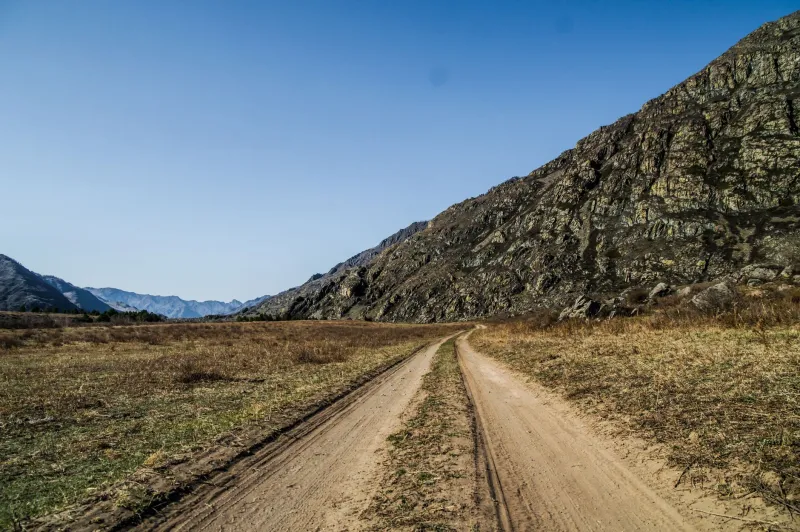
For a guy who grew up in Ohio learning to drive on the assumption that every road goes somewhere, this does something to your brain. There's no fork in the road. There's no road. There are tire tracks, dozens of them, fanning out across the steppe like spilled spaghetti, and every single one was made by somebody who knew exactly where they were going.
The trick, of course, is figuring out which track is yours.
Directions You Can't Screenshot
Out here, navigation isn't an app. It's a conversation.
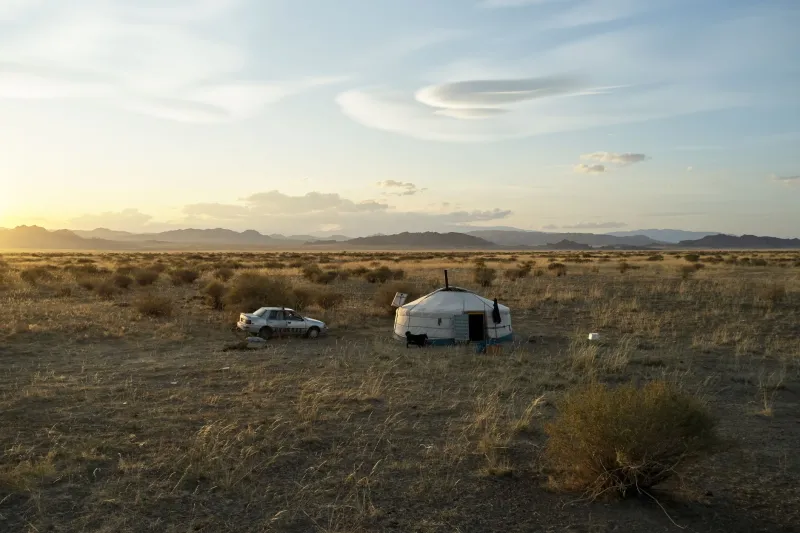
You stop at the first ger you see — and you always stop, because that's the rule, not the strategy. You drink the tea you're offered, answer the questions about where you're really from, and then you ask about the road to the next sum. What you get back is not turn-by-turn. It's something closer to poetry with mileage attached.
"Drive until the second river, the one with the white rocks. Turn toward the sun where the old Soviet fence posts are. If you reach the winter camp with the blue roof, you've gone too far."
That's a real set of directions I was given in 2023, and it worked perfectly. It also would have baffled Waze into a coma.
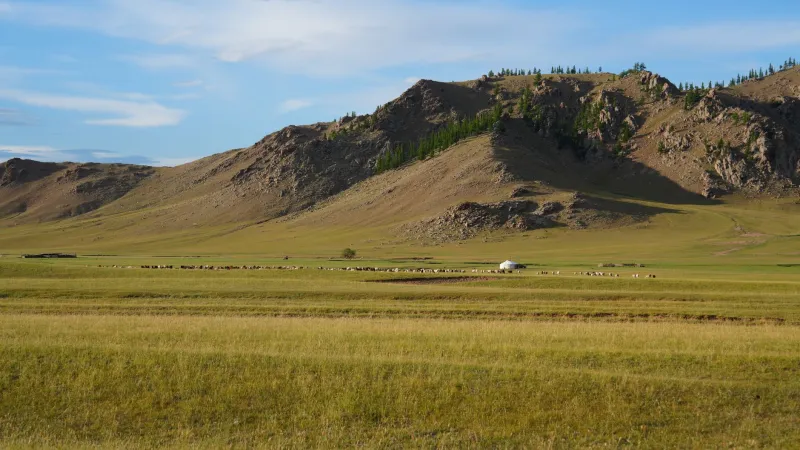
The herders navigate by a thousand small landmarks that never appear on any map: a rock formation shaped like a saddle, a slope where the snow melts first, the grave of somebody's grandfather on a hillside. The land itself is the database, and the people are the search function. Once you accept that, the panic of being "lost" starts to feel a lot like something else — being placed. Located in a way that a blue dot never quite manages.
The Practical Stuff, Because You'll Ask
For the Americans mentally drafting an itinerary right now, a few things worth knowing:
Rent a Russian vehicle or nothing. The UAZ vans and Land Cruisers out here exist for a reason. Whatever SUV you're imagining from the Hertz counter in Denver, forget it. The tracks that look flat on Google Earth will eat a suspension in an afternoon.
Download everything, trust nothing. Offline maps will get you roughly 70 percent of the way and then lie to you with total confidence. Carry a paper map. Carry a compass. Carry the phone number of your driver's cousin, which is honestly the most reliable piece of navigation technology in the province.
Fuel is the real clock. Distances out here aren't measured in miles; they're measured in how many jerry cans you're carrying. Diesel is the truest currency west of Khovd, and running dry isn't an inconvenience, it's a plot twist.
Ask before you photograph, always. The same hospitality that gets you directions doesn't make you invisible. A nod and a gesture toward the camera goes further than you'd think.
Why the Blank Spot Matters
Here's the part I keep turning over, months later, back in a country where my phone knows when I've stopped at a rest area in Nebraska.
We've engineered every last unknown out of American travel. You can pre-book the overlook, pre-order the meal, pre-read every review of the motel. It's efficient and it's deadening. Nothing can surprise you when everything has already been rendered in street view.
The far west of Mongolia is one of the last places on earth where the map simply declines to answer. You have to ask a human being. You have to be, briefly, a guest instead of a customer. And the road — well, the road is whatever line the last driver drew, and the one before him, and the herder's grandfather before that.
I photographed the Altai for six days on that trip and the best frame of the bunch, the one hanging in my studio now, isn't of the mountains at all. It's a shot of two tire tracks converging toward a horizon, taken from the hood of a stalled van while a kid on a horse watched us figure it out.
The black section of the map isn't empty. It's just waiting for you to ask someone.