Hands, Nods, and One Botched Word: Six Weeks in Mongolia Without a Translator
Photo: Pearson, G., CC BY-SA 2.5, via Wikimedia Commons
The One Word I Knew
Before I landed in Ulaanbaatar, I made a decision that would've made my travel agent (my wife) nervous: I wasn't hiring an interpreter. My entire Mongolian vocabulary consisted of bayarloo — thank you — and even that, I'd later learn, I was pronouncing slightly wrong.
Six weeks later, I'd been fed, housed, guided through river crossings, and twice rescued from mechanical trouble, all without a single sentence of shared language. Here's what I learned about how far gestures and good faith can actually carry you.
What Works Better Than You'd Think
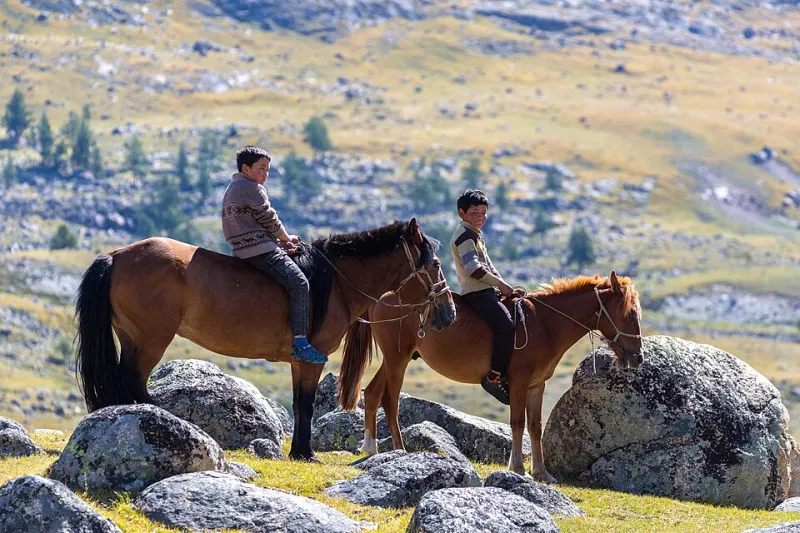
Hospitality in the countryside isn't a transaction the way it can feel back home. When you pull up to a ger on a motorcycle that isn't yours, you're not a customer — you're a guest, and the rules for guests are older and firmer than any language barrier.
I learned to let objects do the talking. Showing a photo of a broken fan belt on my phone communicated more than a paragraph of bad Russian ever could. Pointing at the sky, then at my watch, then shrugging — that's how I asked whether the weather would hold. It usually got me an answer, even if I only understood about half of it.
The universal vocabulary out there, I found, runs something like this: a smile gets you in the door, two hands offering or receiving anything gets you respect, and letting a kid show off by translating gets you further than any app. Teenagers with a few years of English in school became my accidental ambassadors more times than I can count.
The Misunderstanding Hall of Fame
You will fail, and it will be funny, so lean into it.
My personal lowlight: trying to ask for milk and instead asking for what I can only assume was a small animal, based on the family's reaction. The grandmother laughed hard enough that she had to sit down. I drank the milk. It was excellent.
Another time I nodded enthusiastically at an offer of fermented mare's milk, believing I'd agreed to smell it. I had not. If you've never had airag, understand that agreeing to it is a commitment, and backing out midway is the actual rudeness I'd been so worried about.
The lesson from every fumble was the same: Mongolians in the countryside forgive language mistakes constantly and generously. What they don't forgive is standoffishness. A traveler who tries and flops is charming. A traveler who stays behind their camera and their phone is just another stranger.
When You Actually Do Need a Translator
I'm not going to romanticize this into nonsense. There are moments when a shared language isn't optional, and pretending otherwise gets people hurt or embarrassed.
Hire or borrow a translator when:
- You're conducting interviews or photographing people for anything beyond personal use — consent needs to be real, informed, and specific
- You're negotiating a multi-day guide, horse trek, or vehicle hire where money changes hands
- You have a medical condition, allergy, or dietary restriction
- You're attending a ceremony, wedding, or anything ritual, where the choreography has rules you can't guess
- Something goes genuinely wrong — an injury, a dispute, a police matter
The trick I landed on: you don't need to hire a translator for most of these. You need to find one. A well-timed stop in a soum center, a friendly teacher, a herder's cousin visiting from UB — rural Mongolia is full of people willing to spend twenty minutes translating if you've already made a good impression. That goodwill, though, has to be banked in advance, in smiles and bayarloo and washed teacups.
A Field Kit for the Wordless
A few things that earned their place in my bag:
A translation app with offline Mongolian downloaded. It's slow and often hilariously wrong, but for logistics — what time, how far, how much — it closes gaps gestures can't.
Photos of where you've been and where you're going. A map screenshot is a sentence anyone can read.
Patience with repetition. Conversations out there run at half speed and loop constantly. That's not inefficiency; that's the rhythm.
Willingness to eat and drink what's offered. Half of communication is demonstrating that you trust people.
The humility to be the joke. If you can't laugh at yourself asking for a goat when you meant milk, stay home.
What the Silence Teaches
Somewhere around week three, I noticed something shift. I'd stopped performing. Back home, I talk — probably too much, like most Americans. Words fill every gap, soften every silence, narrate every moment.
Without them, I just... watched. I paid attention to hands pouring tea, to the angle of a saddle being cinched, to the way a family moved around each other in a space the size of a two-car garage. My memory of those weeks is sharper than any trip where I chattered my way through.
There's a version of Mongolia you can only access by being slightly helpless. It's the version where people lean in, where communication becomes a joint project instead of a transaction, where you're not a client being serviced but a guest being decoded.
Was it efficient? Absolutely not. Would I do it again, one word and all? Without hesitation. Some of the best conversations of my life happened without either of us understanding a thing the other said.