Rodeo Country Meets the Steppe: An American's Honest Take on Naadam
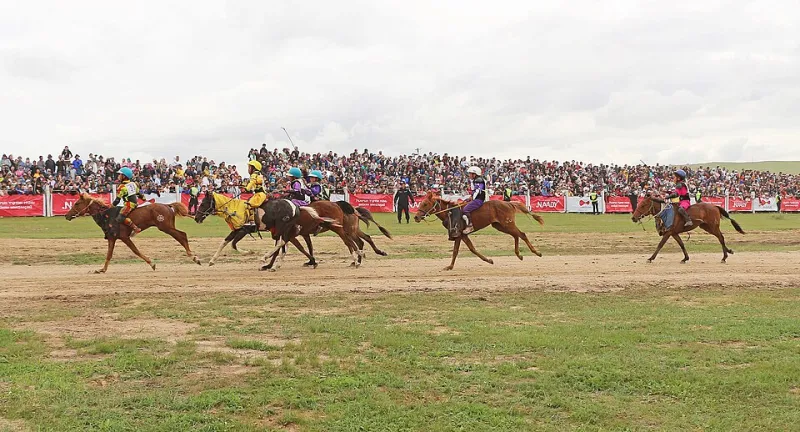
Photo: Bernard Gagnon, CC0, via Wikimedia Commons
I Showed Up Expecting a Rodeo
The first Naadam I attended, I carried some unexamined assumptions in my luggage alongside my camera gear. Wrestling, horse racing, archery — a national festival built around competitions of strength and skill? Surely this was Mongolia's version of Cheyenne Frontier Days. I'd grown up around Montana rodeos; I figured I had the genre covered.
By the second day, I'd quietly retired that comparison. Not because Naadam is better than a rodeo — that's not the argument I want to make — but because it's asking a fundamentally different question.
What a Rodeo Is Built For
An American rodeo is, at heart, entertainment with roots. It celebrates a working tradition — cattle handling — and packages it for an audience. There's nothing wrong with that. The rodeos I loved as a kid were loud, fast, and fun. There's a winner every night, a buckin' chute, a scoreboard, a bull rider dusting off his hat. The individual is the story. Someone triumphs; everyone else tries again next weekend.
Naadam borrows the surface vocabulary of that world — competition, spectacle, national pride — but the grammar underneath is completely different.
What Naadam Is Actually About
Consider the horse race. At the big races outside Ulaanbaatar, children as young as seven or eight ride across open steppe for distances up to 30 kilometers. Not laps around a dirt arena. Open country, weather included, hours of it.
Nobody hands out prize money that changes a life. The winning jockey gets songs sung about them, yes. But here's the detail that rewired my understanding: spectators talk for years about the horses that finished last, the ones that made the distance at all. Endurance itself carries honor. There's a Mongolian saying to the effect that the horse that finishes last still crossed the whole country.
Same with wrestling. The tournament bracket winnows hundreds of men down to one champion, but the ritual dancing — the hawk-like dekh choreography before and after every bout — matters as much as the result. And archery, the third of the "three manly games" (despite being open to all genders these days), is judged less on defeating an opponent than on collective breathing and calm. The crowd helps the archer. Imagine a rodeo crowd doing that.
The Crowd Is the Event
That's the deepest difference. At a rodeo, the audience watches the competitors. At Naadam, the audience is participating — picnicking in the stadium aisles, sharing airag, arguing rankings across generations, wearing their best deels. Families travel for days to be there. The competition gives everyone a reason to gather; the gathering is the point.
I photographed a grandmother in Ulaanbaatar who had attended every Naadam for six decades. She had no interest in telling me who won anything. She wanted to show me her spot on the stadium steps — the same spot, she said, since she was a girl.
I can't imagine a rodeo fan describing their seat that way. And rodeo folks would find Naadam's pace maddening: hours of ceremony, long pauses, a schedule that treats time as a suggestion. Both would be right, from where they sit.
If You're Going (Sidebar for the Curious)
- Time it right. The main festival runs July 11–13 nationwide, but smaller sum-level Naadams happen through the summer and are far more intimate.
- Book early. Domestic flights and hotels in July fill up months ahead. Ulaanbaatar is lively, but a countryside Naadam is where the essay above really lives.
- Dress with respect. You don't need a deel, but leave the shorts and tank top at the hotel. Sun protection doubles as good manners.
- Ask before photographing wrestlers and jockeys up close — you'll almost always get a yes, but the asking matters.
- Stay for the whole thing. The closing ceremonies are when the community feeling peaks, and most visitors have already left for the airport.
Two Festivals, Two Questions
A rodeo asks: who is the best tonight? Naadam asks: are we still here, still strong, still together? One celebrates the individual's moment; the other rehearses a people's continuity.
I'll keep going to both. But if you've got one July to spend, and you want to understand a country rather than watch a show — buy the ticket to Ulaanbaatar, then keep going past it.