The Floor Plan Is a Philosophy: Decoding the Inside of a Mongolian Ger Before You Sleep in One
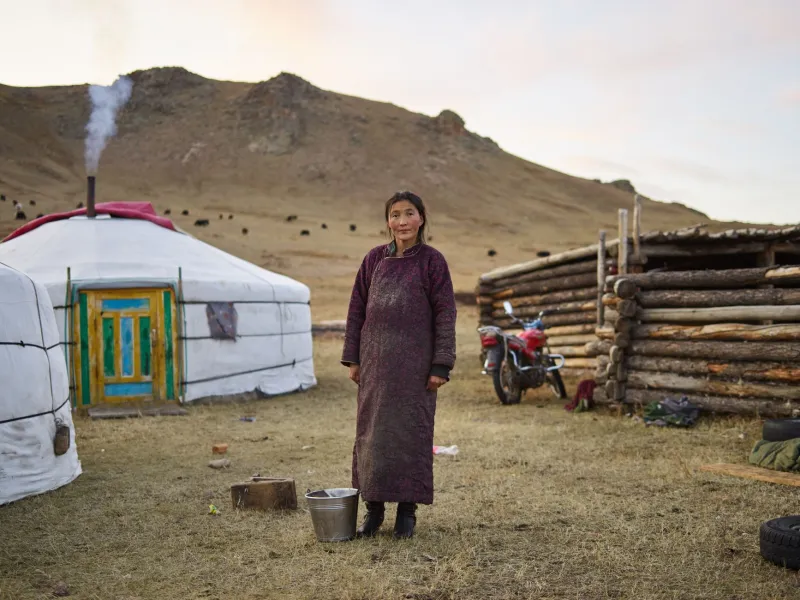
The first time I slept in a ger, I did everything wrong. I sat in the wrong seat, set my camera bag on the wrong side, and stepped on the threshold like I was walking into a Motel 6. Nobody said a word. Mongolian hospitality has a patience with outsiders that I still don't fully deserve.
But I've been back enough times now to know that a ger isn't just a tent. It's a blueprint — of the family, the sky, the year, the whole cosmology — packed into a round felt-walled room you can cross in four steps. And if you're heading out for a homestay or photographing inside one, you'll get better pictures and better tea if you learn the floor plan first.
The Room Is a Compass
Stand at the door and look in. The altar — a small shelf with Buddhist objects, framed photos, and offerings — sits directly across from you, on the khoimor, the most honored spot in the home. Elders and respected guests are seated there. You, as a first-time visitor, will probably be steered to the left side, the guest side, which is exactly where you should want to sit.
The right side belongs to the household — the man's domain, where saddles, tools, and the family's goods are stored. Left is for guests and the woman's work. This isn't decoration; it's a diagram. When I photograph an interior, I try to make the composition reflect that logic: altar centered, family on the right, guests on the left. The room tells you how to frame it.
Furniture With a Job Description
There's not much in a ger, and nothing is arbitrary.
- The stove (zuukh) sits dead center. It's the heart, the heat source, and the boundary between fire-related rules — never put trash in it, never step over it, never lean on the frame.
- Beds run along both walls. The head of the household sleeps on the right; children and guests fill the rest. If you're handed a bed spot, that's not a hotel assignment, it's a rank.
- The chest sits behind the altar, holding the family's valuables. It's the closest thing to a safe deposit box on the steppe.
- Felt hangings and zolotik decorations near the roof aren't just pretty — they mark status and sometimes region, the way a quilt pattern might mark a county in Appalachia.
Open-plan living this is not. Every object faces the center, the way the whole culture orbits the hearth.
The Door Rules (Yes, There Are Rules)
Three things to burn into memory:
- Never step on the threshold. Step over it, cleanly. The threshold carries the home's fortune — stepping on it is like stepping on someone's foot, but worse.
- Enter feet first, and don't linger in the doorway. Come in on the right side of the door, moving clockwise.
- Don't whistling indoors. It's said to summon bad spirits — or at minimum, to make your host think you're mocking the room.
I got the threshold thing wrong for two trips. When a herder finally mimed it for me — a slow, exaggerated step-over — I felt like someone had handed me the owner's manual six years late.
Sitting, Drinking, Receiving
Inside, sit with your feet tucked under you or cross-legged — never with your feet pointed at the stove or the altar. When tea arrives, take it with your right hand or both hands. Supporting your elbow with your left hand is the polite flourish; it signals that the gift is received with your whole body.
Same with a snuff bottle, a bowl of airag, a plate of aaruul. Two hands. Always two hands.
Why Photographers Should Care
Here's the practical part. A ger interior is low, dim, and lit by one central stove plus a skylight at the top of the crown. It's also the most compositionally disciplined room you'll ever shoot. The circle imposes order: the altar anchors your frame, the stove gives you your key light, and the smoke hole gives you a soft top source that no softbox improves on.
But the real reason to learn the etiquette is access. Families let you photograph deeply — mornings, meals, kids doing homework by lamplight — when you behave like someone who understands the room. Step on the threshold once and you'll get the polite, distant version of hospitality. Get it right, and by the second night you're shooting from the honored seat.
A Bookmark for Your Booking
If you're the type who reads restaurant reviews before making a reservation, print this out before you book a ger homestay. The rules aren't ornamental — they're the operating system of a home that moves four times a year and still keeps everything in its place.
And when you get it right, something shifts. The host stops watching you. The tea keeps coming. The camera stops being a stranger in the room, because you already stopped being one.