Batteries in the Felt, Prayers to the Sky: Chasing the Milky Way Over the Mongolian Steppe
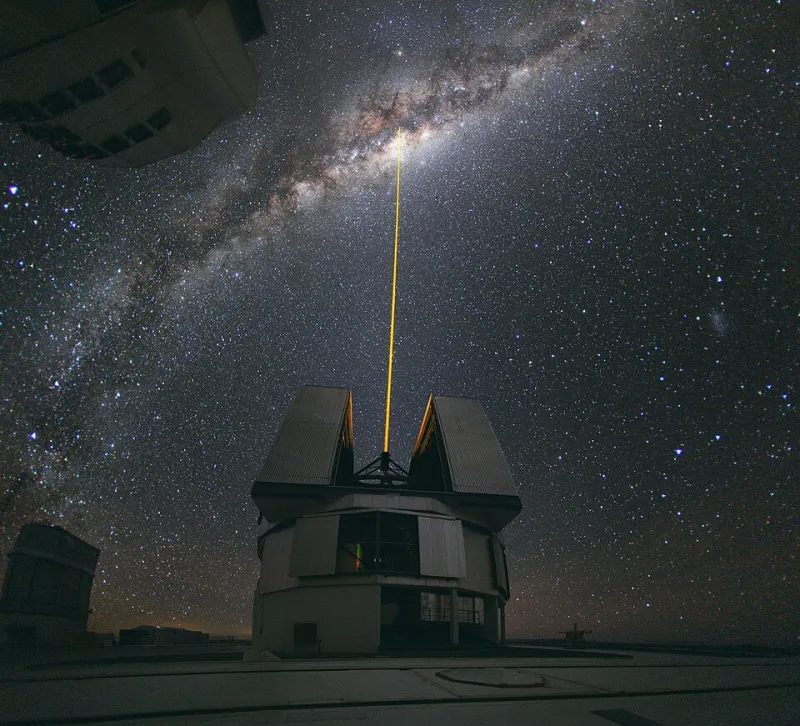
Photo: ESO/Yuri Beletsky (ybialets at eso.org), CC BY 4.0, via Wikimedia Commons
The first night I spent in the western steppe, I did something embarrassing. I walked out of the ger around 2 a.m., looked up, and sat down in the grass. Not for the shot. I just sat there, because I genuinely couldn't find a constellation I recognized. The sky was so crowded it stopped reading as a sky.
If you've done astro work in the States — Death Valley, maybe, or a designated dark-sky park in Pennsylvania — you think you know what dark means. You don't, not yet. Mongolia has essentially no light pollution across hundreds of kilometers. Outside Ulaanbaatar, the country is one of the least illuminated landmasses on the planet. There is no distant glow on the horizon. There is no horizon glow at all.
Why Americans Keep Flying Over This Place
Here's what puzzles me. US astrophotographers will drive six hours to a dark-sky reserve and share a viewpoint with forty tripods and someone's Bluetooth speaker. Meanwhile, Mongolia — darker, emptier, with a Milky Way that casts a faint shadow on frost — gets a fraction of the traffic. Part of it is logistics. Part of it is that nobody posts about a place until everyone else already has.
Consider this your nudge. The window when you can shoot the galactic core rising over open grassland, completely alone, is still open. It won't be forever.
The Cold Is the Real Opponent
Your camera can handle the steppe at night. Your batteries cannot.
In October, temperatures drop well below freezing, and a lithium battery that read 80% at midnight can be dead by 2 a.m. I learned this the hard way during an eagle hunter shoot in the Altai, when both my spare batteries went flat in an outside pocket while I fumbled with a focus ring.
The fix I use now, borrowed from a herder's common sense: batteries live inside the ger, close to the stove or in an inner pocket against your body. You bring them out only when you're ready to shoot. Keep the spare against your chest, under the down layer. Rotate. It's tedious and it works.
A few other field notes:
- Condensation is the silent killer. Coming from -15°C into a warm ger will fog every glass surface you own. Let gear acclimate in the entryway, the small transition space, before bringing it fully inside. Or bag it airtight and let it warm up sealed.
- Manual focus, always. Autofocus hunts uselessly at night. Find a bright star, focus on it, tape the ring if you have to.
- Scout in daylight. There are no trail lights, no parking lots, no landmarks. What looks like flat ground at 10 p.m. might be a riverbank.
- Bring more power than you think. I carry a small power bank rated for cold weather and keep IT warm too. Everything on the steppe is cold. Everything.
Settings, Briefly, Because You Know Most of This
You've shot stars before, so I'll keep it short: f/1.8–2.8, ISO 3200–6400 as a starting point, and shutter speeds under 15 seconds if you want pinpoint stars at 24mm. The trick nobody tells you about the steppe: the air is so clean and dry that you can push ISO higher than you'd dare at home with almost no noise penalty from haze. Long exposure noise reduction off in the field — the dark frames eat your battery — and clean up in post.
What you can't prepare for is the wind. The steppe is a flat, open runway, and a flimsy tripod turns your 15-second exposure into abstract art. Hang your pack from the center column. Or do what I eventually did and put a sandbag weight in your kit from day one.
The Sky Isn't Empty to Everyone
Here's the part I want you to sit with, because it changed how I photograph out there.
For Mongolian herders, the sky has never been a backdrop. Traditional belief across the steppe holds the eternal blue sky — Tengri — as sacred, and you'll see ovoo, the stone cairns draped in blue khadag scarves, standing on high points across the country. Travelers circle them clockwise and add a stone. The sky isn't scenery. It's a presence, something you live under and answer to.
Once a herder family noticed me setting up my tripod at dusk, and the grandmother asked, through our translator, why I needed a machine to look at the sky. I didn't have a good answer then. I still don't, entirely. But it reframed my work: I stopped trying to make dramatic sky photographs and started trying to make honest ones — the sky as the herders experience it, vast and ordinary and above everything.
Etiquette Before Exposure
A few practical courtesies, since you'll likely be shooting near a family's ger:
- Ask before you set up near their camp. Always. A nod and a gesture goes a long way.
- Don't walk toward the ger at night with a headlamp blazing — it reads as alarming. Announce yourself early and dim your light.
- Offer to show them the back of your camera. This has never once been a mistake. Kids especially lose their minds over a photo of the Milky Way.
- Never shoot people at night without asking, same rule as daylight, same rule as anywhere.
Come Home With Something You Can't Get at Home
There are darker skies on paper — high deserts, remote islands. But nowhere I've stood combines this darkness with this sense of human scale: a single ger's stovepipe smoke rising against a galaxy, a horse shifting somewhere out in the black, the whole thing silent in a way that no place in the lower 48 is silent.
You'll spend a fortune getting there and a fortune on the internal flight west. Your batteries will suffer. Your fingers will suffer more.
And then you'll stand in the grass at 2 a.m. under a sky with no edges, and every crowded dark-sky park you've ever shot will feel like what it was: a rehearsal.